

A denied claim is easy to see, but the workflow that caused it can be far more subtle.
Maybe a provider’s charge was submitted late. Maybe patient information was incomplete, documentation did not support the service performed, or the cause was something entirely less obvious.
By the time the denial appears, the real problem may have happened days or weeks earlier.
AI can help identify patterns, prioritize work, and surface potential problems faster than a person working through a queue one claim at a time.
However, finding the problem is not the same as fixing its cause.
Why Do the Same Claim Denials Keep Happening?
When the same type of denial happens repeatedly, working each claim individually only solves part of the problem.
The more important questions are upstream:
- Why does this keep happening?
- Is it isolated to a certain provider, facility, payer, or workflow?
- Where is information getting lost or delayed?
- And what needs to change so the next claim does not have the same problem?
Answering those questions entails more than understanding the claim itself. It requires knowledge of how the practice operates before that claim ever reaches a payer.
For high-acuity practices such as hospitalists, geriatrics, infectious disease, critical care, and nephrology groups, that context can be particularly important. The revenue cycle begins long before a claim is submitted, with charge capture, patient information, documentation, and the workflows connecting them.
A problem at any one of those steps can eventually show up as a denial.
And front-end data problems are not uncommon. Experian Health’s 2025 State of Claims survey found that 26% of respondents said at least one in ten denials at their organization could be traced back to inaccurate or incomplete data collected during patient intake.
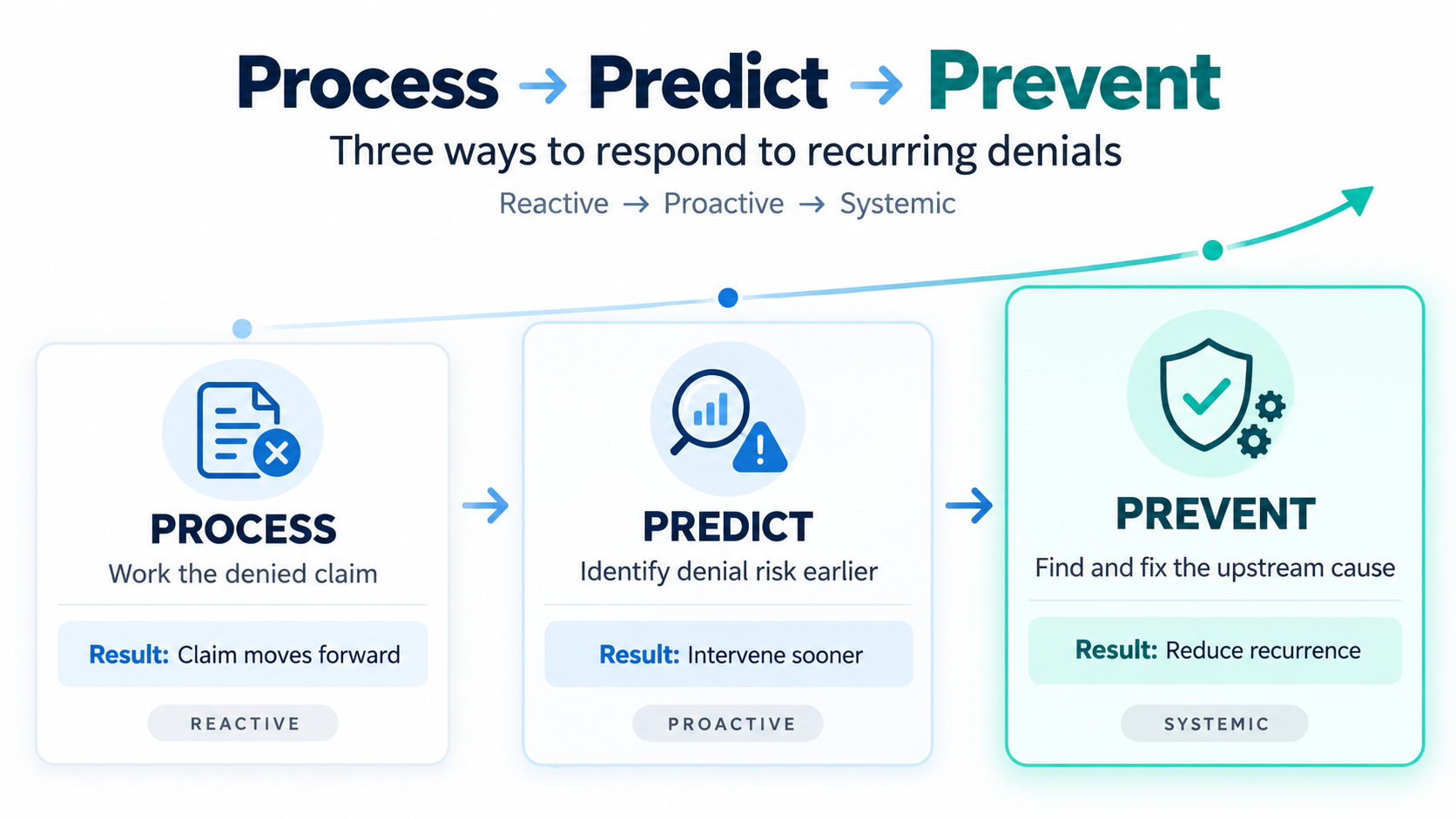
Denial Management vs. Denial Prevention: Process, Predict, Prevent
There are three ways an RCM operation can respond to a recurring problem.
All three responses matter. But prevention can create a more durable impact because it addresses the process producing the problem, not just the individual claim.
If certain types of claims repeatedly require correction, the answer should not always be faster corrections. The better question is whether something can change so fewer of those corrections are needed at all.
Case Study: Tracing Recurring Denials Back to the Workflow
We recently saw this firsthand while implementing pRevenue for a busy multi-provider nephrology practice.
Phase 1: Workflow Documentation
Before taking over the revenue cycle, our team worked with the practice to document their existing workflows.
We looked at the big picture, including how information moved from demographics intake through billing, but also at the details that determine how those workflows function day to day, including how faxed documents and facesheets entered the process.
The goal was to understand how information actually moved through the practice before we began changing it.
Phase 2: New Workflows in pMD
We then implemented new workflows directly within pMD.
That’s when the upfront documentation paid off.
Once billing activity began moving through the connected pMD workflow, we identified a recurring pattern involving missing demographic and insurance information. Complete demographic and insurance data is critical to preventing downstream billing issues and meeting timely-filing requirements.
Because we had already documented the workflows leading up to the claim, and the resulting billing activity was connected within pMD, our team had the context to trace the problem backward.
The root cause became clear: staff were sometimes forgetting to update demographic and insurance information during the check-in process.
Phase 3: Resolving the Issue
We didn’t simply correct the affected claims and move on.
We flagged the underlying issue for the practice administrator and worked together to change the process that was creating it.
Drawing on pMD’s experience working closely with specialty practices, we built a new check-in workflow directly within the pMD platform. The updated process created guardrails to help ensure that the necessary information was collected for every patient.
The step-by-step workflow was repeatable, trackable, and easy for staff to resume if only partially completed. In a distraction-filled office environment, those characteristics helped reduce the reliance on staff remembering every step on their own.
Fixing the Source Means Fewer Problems Downstream
The result was more than resolving an individual claim. By addressing the source of the problem, we changed the workflow that was allowing the same issue to recur.
That’s the difference between managing a denial and improving the revenue cycle that produced it.
Where AI Fits in Medical Billing: AI-Supported, Not AI-Reliant
At pMD, we believe AI should make a strong revenue cycle team better, not replace the work that requires judgment, context, and accountability.
Technology can help identify patterns, reduce repetitive work, and bring potential problems to the surface.
But technology is only part of the system. With pRevenue, our RCM team can look beyond an individual claim to understand what is happening across the broader revenue cycle. We investigate recurring issues, identify their root causes, and work with practices to improve the workflows contributing to them.
Sometimes the source is in billing. Sometimes it is charge capture, documentation, patient information, or how data moves between systems.
Technology helps make the pattern visible. The connected workflow provides context. Our RCM team helps determine what the pattern means, and our partnership with the practice helps change what happens next.
That is what AI-supported, not AI-reliant looks like in practice.
What Should You Ask an RCM Partner About AI and Denial Prevention?
A billing service should improve the process, not simply move claims through it.
When something goes wrong, your RCM partner should go beyond telling you what happened to the claim. They should help you understand why it happened, whether it is part of a larger pattern, and what can be done differently upstream.
When evaluating an RCM partner, ask more than what their AI can automate or predict.
Ask any RCM partner these questions, including us:
- What happens after their technology finds a problem?
- Who investigates the root cause?
- Who works with your practice to fix it?
- How will they prevent the same problem from showing up again?
At pMD, identifying the issue is only the beginning. Our RCM team looks beyond the individual claim to understand whether the problem is isolated or part of a broader pattern, traces it back through the surrounding workflow, and works directly with the practice to improve the process that contributed to it.
That’s the difference between simply managing denials and building a revenue cycle that gets better over time.
AI can help identify the problem.
Building a better revenue cycle means learning how to prevent the next one.
Want to know where preventable denials may be starting in your revenue cycle? Talk with the pRevenue team about your current workflows and opportunities to improve them.
To find out more about pMD's suite of products, which includes our billing services, charge capture and MIPS registry, telehealth and secure communication software and services, please contact pMD.


Have questions?
We have answers!
